

The Distance between us
Part 1 - The Spiral of Division and the underlying Mechanism. Why History keeps repeating itself.

Thirteen years ago, I wrote my final paper.
Its title was simple:
Fear as a Tool of Power in Politics and Society.
At nineteen, I thought I was writing a history paper.
Looking back, I think I was trying to understand my own life.
Together with a close friend and collaboration partner, I spent months researching two events that, at first glance, seemed impossible to compare: the attacks of September 11th, 2001, and the Reichstag fire of 1933, which was the initiation to the second World War.
We were not trying to prove that these events were identical. They weren’t.
Our questions were different.
How do societies react to collective shock?
How do narratives change?
How does fear spread?
And perhaps the biggest question of all:
What happens to a society when certainty suddenly disappears?
As part of our work, we had the privilege of speaking with Professor Daniele Ganser in Basel.
I still remember his office.
Books stacked everywhere. Papers spread across his desk.
The kind of room that immediately invites questions.
I arrived with notes, references and historical facts.
I left with something else entirely.
Questions.
Questions that have stayed with me for thirteen years.
At one point, Professor Ganser leaned forward and looked at me.
“Why fear?” he asked.
I remember hesitating.
Because the truth was, I didn’t know.
I only knew that something had changed after 9/11.
Not only politically.
Not only socially.
Something had changed between people.
And I wanted to understand what it was.
Professor Ganser nodded.
Then he said something I have never forgotten.
“It starts with shock.”
I wrote it down immediately.
It starts with shock.
A sudden event.
A rupture.
A collective loss of certainty.
A moment in which the world we thought we understood no longer makes sense.
Then he asked another question.
“What do people seek when certainty disappears?”
I thought for a moment.
“Safety?”
He smiled.
“Certainty.”
The answer surprised me.
The older I get, the more I understand it.
Because uncertainty is difficult to hold.
We want answers.
We want explanations.
We want someone to blame.
We want to know who belongs and who doesn’t.
Who is safe.
Who is dangerous.
Complexity suddenly becomes unbearable.
So we simplify. And this is where the spiral begins.
Because after shock often comes separation.
Us.
And them.
Good.
And bad.
Safe.
And dangerous.
Professor Ganser paused for a moment.
“Do you remember what George W. Bush said after 9/11?”
I nodded.
“You are either with us or against us.”
Then he asked me a question I wasn’t expecting.
“What happens to nuance when you are only given two sides?”
I didn’t answer.
Why? Because I already knew.
Nuance disappears.
Complexity disappears.
The space in between disappears.
And perhaps this is where the spiral truly begins.
Because once the world becomes divided into us and them, every human being standing in the space between those two poles is suddenly forced into a choice.
Take sides. Choose an identity. Declare your loyalty. Pick a camp.
And the moment this happens, separation has already begun.
I wonder how often we do this ourselves.
Not only after historical events.
Not only after terrorist attacks.
But after breakups.
After sudden loss.
After grief.
After betrayal.
After trauma.
How often do we divide our reality into categories because the whole picture has become too painful to hold?
How often do we create enemies because uncertainty feels unbearable?
Professor Ganser explained that after collective shock, societies become particularly susceptible to simple narratives.
Someone must be responsible.
Someone must carry the fear.
Someone must become the other.
And once the other has been identified, something interesting happens.
The distance grows.
A little more suspicion.
A little more distrust.
A little less curiosity.
A little less humanity.
Until eventually we stop seeing people and start seeing labels.
Religion.
Nationality.
Ideology.
Skin colour.
Political affiliation.
History is full of examples of this.
And perhaps our personal lives are too.
Because the more I reflected on our conversation, the more I began wondering whether societies and human beings break apart in remarkably similar ways.
A collective shock can create fragmentation between groups.
A personal shock can create fragmentation within ourselves.
I have often wondered if heartbreak works in the same way.
If one part of us suddenly rushes into the mind, trying to understand, explain and regain control.
While another part quietly descends into the depths of our being, carrying the grief we cannot yet hold.
One part keeps functioning.
The other waits.
One part says:
“Move on.”
The other says nothing at all.
Maybe fragmentation always begins with a separation from something we cannot yet integrate.
And maybe this is not only true for individuals.
Maybe it is true for societies as well.
I sometimes think of fragmentation as the image of two ones, as the Number 11.
Two pillars.
Standing side by side.
Close enough to see one another.
Too distant to touch.
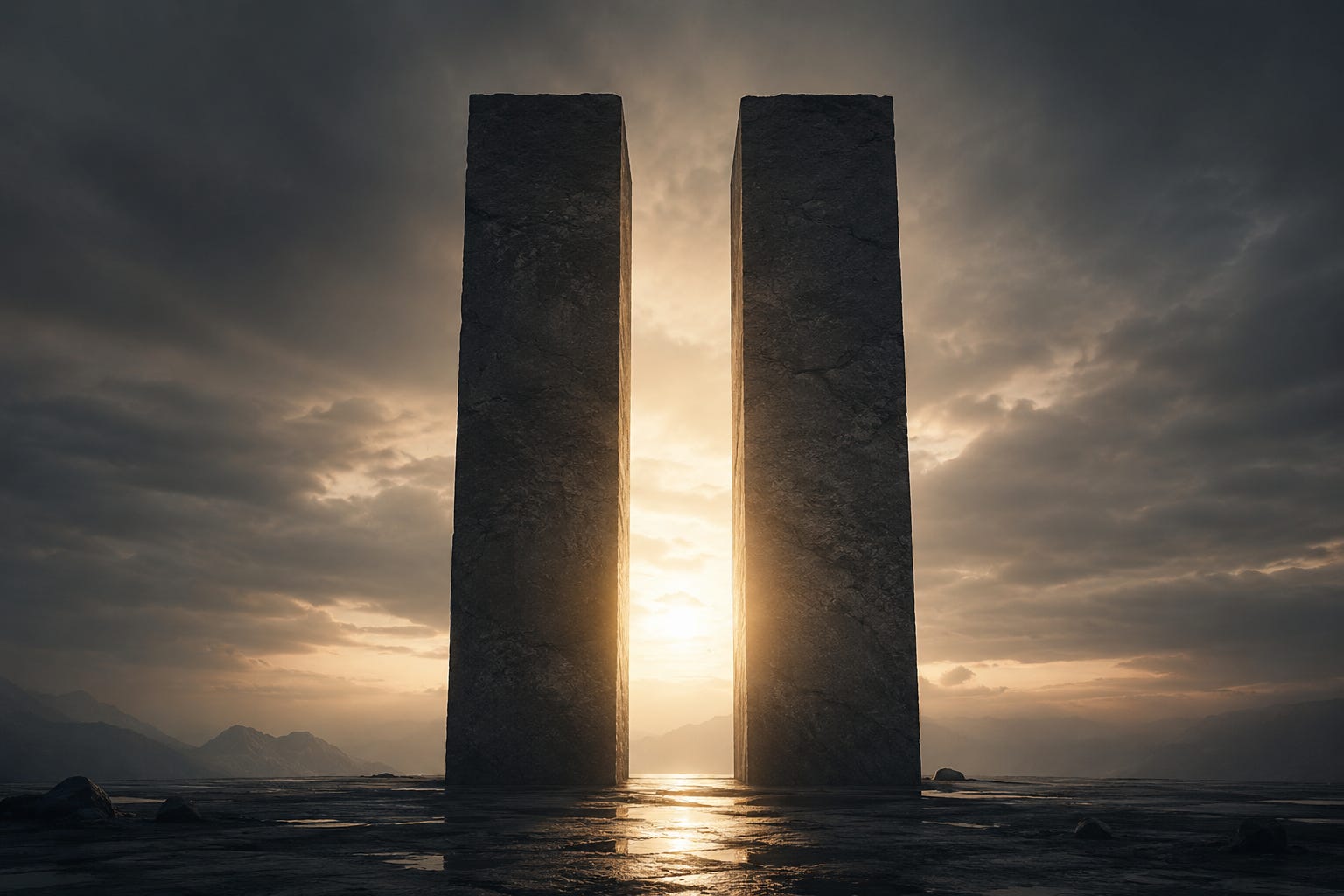
The space between them interests me most.
The unspoken.
The misunderstood.
The inherited fear.
The unresolved pain.
The experiences that were never integrated.
I sometimes wonder whether fragmentation begins the moment we lose our capacity to remain in the space between two opposites.
Between certainty and uncertainty.
Between grief and acceptance.
Between us and them.
Between being with someone and being against them.
Because every conflict seems to create distance.
Not necessarily physical distance.
Psychological distance.
Relational distance.
Human distance.
And once enough distance exists, almost anything becomes possible.
We begin projecting onto one another.
Assuming.
Judging.
Categorising.
Dehumanising.
The other slowly becomes less human and more symbolic.
A representative of our fears. A carrier of our uncertainty.
A screen onto which we project what we do not wish to face.
I often wonder if this is why history keeps repeating itself. Because the mechanism itself never changes.
Only the names change.
The flags change.
The technologies change.
The narratives change.
But the spiral remains remarkably similar.
Shock.
Fear.
Separation.
Discrimination.
Conflict.
Again.
And again.
And again.
Growing up, I thought the conflict was between Islam and the West.
Lately, I have come to a different conclusion.
I think the conflict runs through every human heart.
I think every one of us knows what it feels like to divide the world into us and them.
To create enemies. To protect ourselves through certainty.
To reject parts of ourselves we do not yet know how to integrate.
To distance ourselves from people who remind us of something we cannot yet hold.
Perhaps this is why Professor Ganser words stayed with me for thirteen years. Because he wasn’t simply explaining history. He was describing a human mechanism.
A pattern.
A spiral.
One that can emerge within societies.
Within families.
Within communities.
Within relationships.
And within ourselves.
The more I studied history, the less interested I became in events themselves.
I became interested in the distances they create.
The distance between groups.
The distance between identities.
The distance between parts of ourselves.
Which leaves me with a few questions.
How much of what we call conflict is actually fragmentation?How much of what we call division is simply unintegrated fear?
And how many of the people we perceive as “the other” are carrying wounds remarkably similar to our own?
I don’t have answers to these questions.
I only know that thirteen years after sitting in Professor Ganser office, they feel more relevant than ever.
Because if the spiral of division begins with distance, perhaps every act of genuine understanding becomes an interruption of that spiral.
And if fragmentation exists both collectively and individually, perhaps every attempt to integrate what has been separated also becomes an act of peace.
Which leaves me with one final question, one final invitation.
What happens to a child when the world becomes afraid of people who look like him?